
Supplier Selection
Supplier Selection
Evaluate the impacts of supplier
perfomance on inventory and
material costs
Skip the intro, take me to the Calculator
Supplier Selection Scenarios
When designing a new product, several levels of supplier selection decisions must be made. First, the organization must decide whether a part or subsystem (we will refer to either as a “component”) is designed uniquely for the product or selected from a set of standard components. (In some cases, the standard component may have been previously designed uniquely for a different product.) Once the component has been specified, the organization must decide who supplies the component.
There are five main supplier selection scenarios shown below. This calculator will consider decisions under the fifth scenario.
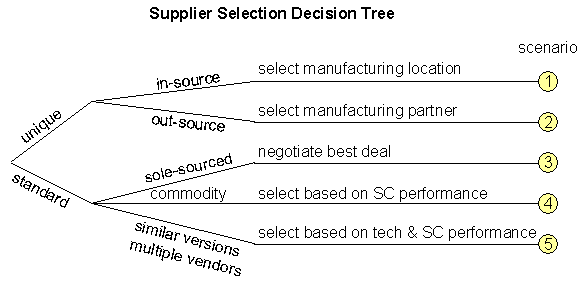
- If the component was uniquely designed, the company may decide to manufacture internally
- The company may also decide to outsource manufacturing
- If the component was selected from a “sole-sourced” supplier, there are few options — the company must try to negotiate the best terms possible
- If the component is a pure commodity, then company may select from one or more vendors based on various supply chain performance criteria
- If similar versions of the component can be obtained from multiple vendors, the company must trade-off technical and supply chain performance criteria
The first four scenarios are predominantly driven by procurement and supply chain functions with only minor input from engineering. The part specifications have been given and the design is complete.
The fifth scenario, however, requires close interaction between engineering, procurement, and supply chain organizations. The Supplier Selection Calculator was designed for this fifth scenario.
Trading-off Materials Costs, Technical Performance and SC Performance
Engineering organizations are usually motivated to maximize technical performance and minimize material costs. This calculator will help you trade-off increased material costs against lower inventory costs. Decreased technical performance (if relevant to the decision) may or may not be a “show-stopper.” There are two situations when engineering might be willing to accept higher material costs and lower technical performance.
First, if the technical performance of the component relates only weakly to overall product performance. Usually, these types of components must only carry-out simple functions at or above a minimum level of performance. Better performance does not increase overall product performance and is simply “wasted.” You may be able to substitute a lower performance component so long as it still meets the minimum thresholds.
Second, if the technical performance of the component can be compensated for by “tuning up” another component that has “excess performance.” In most systems of moderate complexity, there are sufficient interactions between components that this type of compensation may be possible at little or no cost.
For these same two reasons, you may be able to use common parts and subsystems across multiple products. As shown in the Commonality Calculator, this is also a way to reduce inventory costs.
Inventory Impacts of Supplier Performance ?
As mentioned in the Inventory vs. Material Costs Calculator, there are four primary supplier factors that directly impact inventory.
First, lead time. The longer the lead-time, the farther out the forecast period, and the greater the chance that the amount required will be different from the amount that actually arrives. In addition, the shorter the lead time, the shorter the pipeline inventory. With long lead times (e.g. ocean freight from Asia to North America), pipeline inventory can be significant. Generally, if you pay for the components when you place the order, you are responsible for pipeline inventory. If you pay for the components when you receive the order, you are not. Of course, payment terms and return policies complicate this distinction.
Second, lead time reliability. The more uncertain the lead time, the higher the inventory buffers that are required. You don’t need to hold as much inventory when suppliers perform reliably.
Third, delivery frequency. The more frequent the deliveries, the shorter that components sit around before they are built into products. If deliveries are every month, then the average working inventory is about 2 weeks (about 4 weeks at the beginning of the month and 0 at the end, so an average of about 2 weeks). If deliveries are every week, then the average working inventory is ½ week. Frequent deliveries are usually obtained from local suppliers or those suppliers who establish programs like just-in-time and vendor hubs.
Fourth, component yield. In some cases, arriving components may be defective or otherwise unusable in a product (e.g. the component has wider tolerances than the design or manufacturing process requires). Yield has three main effects.
- It increases effective lead time. Only a fraction of the order will take the normal lead time. The defective components must be reordered, and then some of those replacements will be defective and need to be reordered, etc.
- It increases material costs (assuming the supplier doesn’t send free replacements.
- It increases ordering and rework costs for ordering replacements and fixing the assemblies (if the defects are not caught in an incoming test).
See below for a more detailed description of all the parameters used in this calculator.
To use the calculator, simply change one or more of the blue numbers and then click the Calculate button.
| Supplier | One | Two | Three | |
| Annual holding cost (h) | (%) | |||
| Inventory cost (c) | ($/unit) | |||
| Component yield (y) | (%) | |||
| Responsible for cost of defective? | ||||
| Inventory Inputs | ||||
| Delivery frequency (f) | (per week) | |||
| Target service level (SL) | (same for all) | |||
| Forecast error (fe) | (%) | (same for all) | ||
| Lead time (L) | (weeks) | |||
| Responsible for pipeline inventory | ||||
| Lead time uncertainty (lu) | (%) | |||
| Review period (R) | (weeks) | (same for all) | ||
|
|
||||
| What is the total cost of holding safety stock and cycle stock inventory? | ||||
|
Inventory holding cost |
($/unit) | |||
| Material cost | ($/unit) | |||
| Inventory holding cost plus material cost | ($/unit) | |||
Note: These calculators were created to facilitate rapid analysis of DFSC decisions. Although these calculators make simplifying assumptions, they have proved useful in practice. For complex trade-offs of additional cost factors or for especially important decisions, you may want to perform a more detailed analysis.
Inventory Parameters
- Demand: Mean demand or consumption at an inventory stockpile (units/week). In this calculator, we assume demand of all items is the same.
- Forecast error (fe): Standard deviation of the difference between forecasted and actual customer orders, divided by the mean demand. This ratio is sometimes also called coefficient of variation (CoV). In this calculator, we assume forecast error for all items is the same. Lead time (L): Mean lead time to replenish product into an inventory stockpile (weeks). In this calculator, we assume that lead time for all items is the same.
- Lead time uncertainty (lu): Standard deviation of replenishment lead time divided by the mean lead time. In this calculator, we assume no lead time uncertainty.
- Target service level (SL): The desired percentage of demand periods where there are no stock-outs. It is sometimes called availability rate. Depending on the target service level, safety stock is scaled up or down by a factor “k.” In this calculator, we assume that target service level for all items is the same.
- Review period (R): The period of time in-between physical review of inventory stockpiles (weeks). It is assumed that replenishment orders are placed after each inventory review. For continuous review systems, R is zero. In this calculator, we assume review period for all items is the same.
- Inventory cost (c): The current cost of the inventory, including material costs and any incremental value-add ($/unit).
- Annual inventory holding cost (h): Expressed as a percentage of inventory cost, the annual inventory holding cost typically includes financing, storage, devaluation, and scrap.
- Inventory weeks of supply: Inventory units divided by the mean weekly demand (WOS).